Cornea
Keratoconus Explained: Why Your Glasses Keep Changing
Frequent spectacle changes, ghosting and night glare in your teens or twenties may be keratoconus. What it is, how it is tracked, and why timing matters.
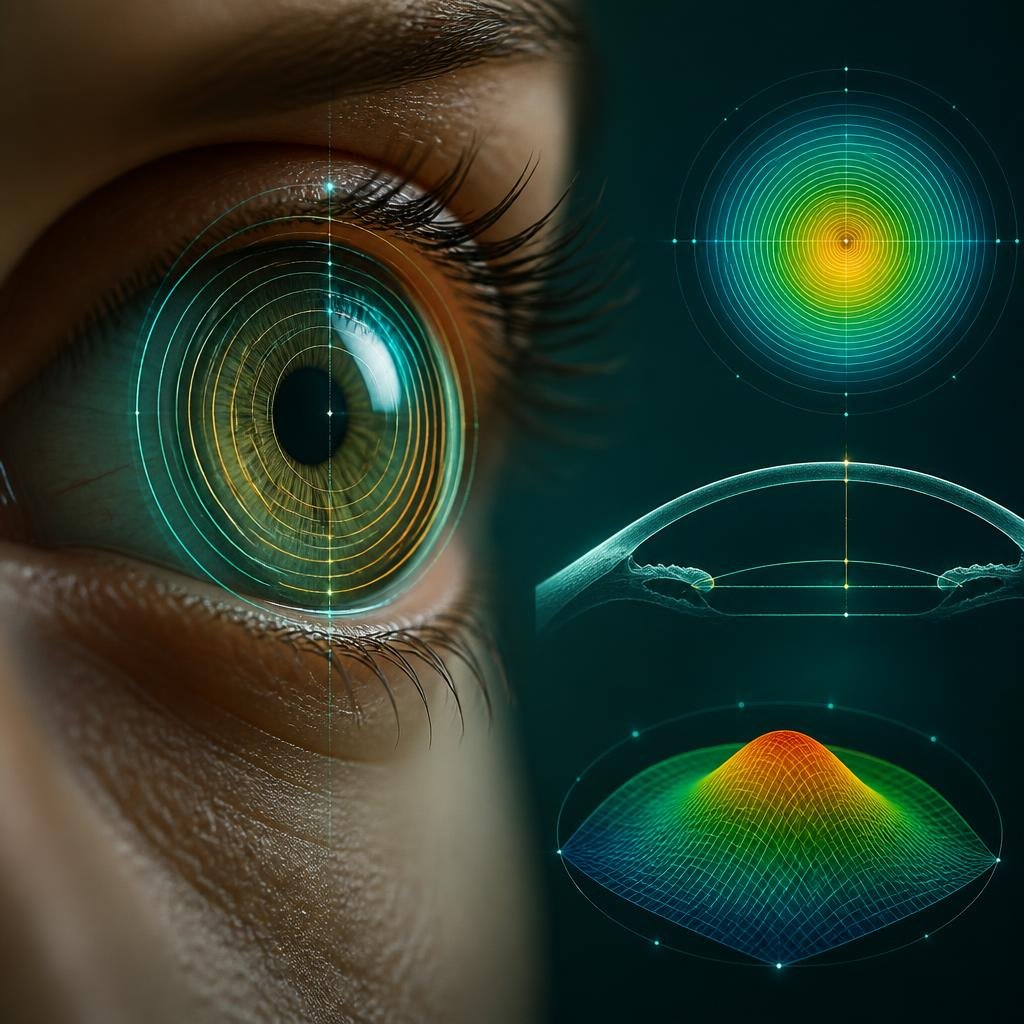
The shape problem
A healthy cornea holds a smooth dome. In keratoconus its collagen framework weakens, the tissue thins, and the dome progressively bulges into a cone. Light then focuses through an irregular surface — and irregular optics cannot be fully corrected by regular glasses, which is why the blur and ghosting persist no matter how often the number changes.
The condition typically starts in the teens or twenties. Both eyes are usually involved, often unevenly, and progression can continue for a decade or more before naturally slowing.
The habits that matter
Two factors are firmly in your control. First: stop rubbing your eyes — vigorous rubbing is strongly associated with progression, and managing allergy is part of treating the disease, not a side note. Second: get screened if keratoconus runs in your family; siblings and children of patients carry a measurably higher risk, and early detection is the entire game.
Stabilise first, then optimise
The treatment sequence has a logic. Corneal collagen cross-linking, when progression is documented, halts the bulge — its job is stability, not spectacle removal. Glasses or specialty contact lenses then deliver the best vision on that stabilised platform. Ring segments help selected eyes; transplantation remains the answer for advanced disease. Each step is chosen from measurements, not urgency.
A single topography scan shows the shape; serial scans show the direction. If your power has changed twice in a year, ask for topography rather than another prescription.
Quick answers
No. Early stable disease is managed with glasses or specialty lenses; surgery enters when progression is proven or optics fail.
Yes. Screens do not cause or worsen keratoconus, though dry-eye habits from long sessions can add discomfort on top.
Not definitely — but the risk is higher. A baseline topography in the late teens is a reasonable, harmless precaution.